Your Air Compressor Buying Guide
Buying an air compressor can be a daunting task. Whether you’re looking for something to pump up the tires on the lawn mower or need a heavy duty machine for a remodeling job, using the wrong air compressor never works out well. Once you understand how an air compressor works and how they’re built, you’ll have the information you need to pick the right air compressor for your jobs.
Three Components of an Air Compressor
The first thing to understand is that there are three basic parts to any air compressor:
air supply, output, and duty size. Let’s break them down.
- Air Flow The amount of pressurized air that flows through the air hose. It’s measured in Cubic Feet per Minute (CFM) at Pounds per Square Inch (PSI). CFM is also found as Standard Cubic Feet per Minute (SCFM). Note that too much air flow can damage tools. (If you’re thinking that this should be obvious, you’re wrong).
- Tank Size Measured in gallons. The size you’ll need will depend on whether your tool requires a steady air flow or only needs short bursts. Pneumatic tools generally require at least a 20 gallon capacity.
- Duty Cycle This is the amount of time your air compressor can run in comparison to the time it has to remain shut down in order to remain functional. The duty cycle is usually reported as a percentage. This is partially determined by the tank size.
Types of Air Compressor Configurations
There are two types of compressor configurations: Single Stage and Two Stage.
Single stage air compressors compress ambient air directly into the tank, while two stage pumps will compress the air once before it delivers it to the tank. The air is then compressed a second time. Twin tank shouldn’t be confused with Twin Stage. Twin tank simply refers to the number of air tanks the air compressor has.
The CFM ratings for single stage compressors are usually below 100 while the PSI rating can go up to 155.
These are suitable for most consumer uses.
Two Stage compressors have PSI ratings over 175 and CFM ratings of 100 and higher.
High air consumption may necessitate having a two-tier compressor. Pneumatic tools usually requite are two stage compressor.
How Air Compressors are Powered
Air compressors can powered by either electricity or gas. Again, the size of the air compressor is usually a determining factor here. Electric compressors that are 110v to 120v are found on most compressors dedicated to small tasks around the house. Compressors with motors that exceed 2 horsepower will require a 220-240v outlet. Don’t run these compressors with a generator.
Gas-powered air compressors should always be used in a well-ventilated area. They’re commonly found on construction sites as they can power nail guns and need no electrical outlet.
Different Types of Air Compressors
Now that you have a better idea of how air compressors work, let’s go through the different types of air compressors out there.
Personal Use
This is your standard home use compressor. These are the pancake/hot dog style and twin-stack compressors. A solid compressor should be able to handle an air brush, fill various tires found around the house: bicycle, lawn mower, car tires and even small truck tires. They are usually a little louder and their tank will run out rather quickly. Their limited tank capacity and horsepower limit their use and are not recommended for pneumatic tools.
Consumer grade compressors are usually labeled oil-less or oil-free.
- Oil-less are low maintenance and nearly impossible to service.
- They’re noisy but not used often.
- The PSIs usually go up to 135 and the CFM are about 7 or lower.
Click Here to Read Our Top Air Compressors for 2021
Professional Use/Portable
A moderately used air compressor. They’re usually gas-fueled motors and have a high horsepower. They can have either vertical or horizontal orientations that feature wheels for easily transporting. Contractors use these on work sites. They should last several hours and be able to power air tools. They require plenty of ventilation and are known for high noise emissions. You’ll want to wear gear to protect your hearing. The tanks range anywhere from a two to three gallon capacity to a 20 to 30 gallon capacity.
As they deliver more power than most portable compressors, they’re also more expensive. Professional compressors are also usually labeled oil-lubricated.
If using with multiple tools one at a time, use the tool that requires highest CFM at highest PSI plus 25 to 50 percent more as your guide. If multiple tools will be used at the same time, the total of all tools’ CFM is the number you need.
DC Compressors
They’re hardwired into a vehicle’s DC system. They don’t take up a lot of room and, of course, are quite popular with the vehicle crowds; RV owners, race teams, etc..
Truck Mounted
Heavier that any other compressor in the Portable category, they are mounted in the truck. You’ll find them where contractors can use them on sites, on tow-trucks and other rescue vehicles.
Stationary
Usually have the highest capacity and power. They are usually anchored with heavy bolts.
These usually have tanks in the 60-80 gallon capacity range with 4 – 10 Hp motors.
Industrial Compressors
These are the compressors you’ll hear at your mechanic’s garage and in any factory setting where the air is flowing 24/7.
Rotary Screw Compressors
Air is compress as it’s pushed through by two screws/rotors that rotate counter to each other. They can be used for sand-blasting and powder coating. Power here doesn’t mean “loud”, however. These technological marvels are quiet and they consume little energy.
Two-Stage Compressors
Most small garages and industrial facilities use two-stage compressors. They can create up to 90 CFM.
Wheel Barrow Compressors
These are heavy duty, come with large capacity tanks and have most of the bells and whistles you dream about. They can also weigh up to 300 pounds (does this sound portable?) so be careful what you wish for.
Features Make the Difference
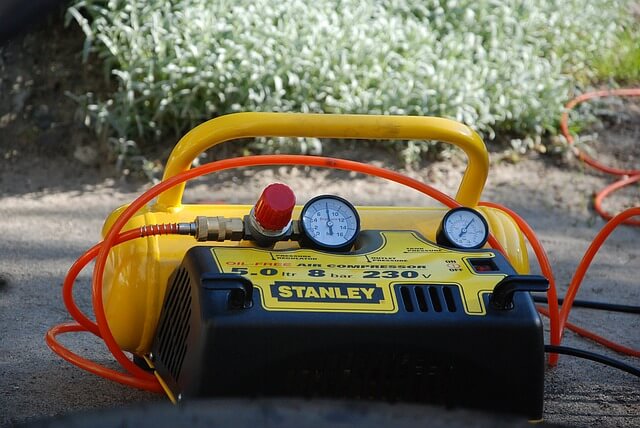
Here are some features that separate working air compressors from great air compressors:
- Idle Control – This saves fuel which saves you money.
- Manual Reset on your electric motor.
- Gauges and Control Panel are easily accessed.
- Ball Valve Tank Lets the tank be drained easily.
- Electric Start with built-in air pressure release.
- Oil-lubed Pump with cylinder made from cast iron.
- ASME Certification means it meets the standards set by the American Society of Mechanical Engineers.
- Roll Cage The protective cage around the tanks and meters to protect it when in use on work sites. An absolute necessity when working with large air compressors.
Recent Posts

Rolair: Innovative Compressed Air Solutions for Industry Professionals
VEVOR 6.3 Gallon Air Compressor Review: Worth the Hype?
Differences Between Oil-Less and Oil-Lubricated Air Compressors
Portable Air Compressors for Home Use: A Comprehensive Guide
JF.EGWO 6000Amp Car Jump Starter Review